Shoah Legacy
All of our parents are Shoah survivors.
They experienced the horrors of the Shoah first-hand: the concentration camps,
the death camps, the slave-labor camps and the death marches.
Scroll down to continue. WARNING: The content is very graphic!
Introduction
Irving’s parents are:
Lilly Gold (Hebrew: Chiah Leah) Born: Ilona Yazowitz in Sevlus Czechoslovakia, February 22, 1919.
Parents: Ignatz Yazowitz, father; Fannie Sobo, mother.
Morris Gold (Hebrew: Chiam Moshe Meir). Born: Mozes Goldenberg in Irshava Czechoslovakia, November 11, 1914.
Parents: Samuel Goldenberg, father; Maria Markovitch, mother.
Married in Irshava, Czechoslovakia November 18, 1945.
The last name was originally ‘Goldenberg’; father shortened it to ‘Gold’ in the 1950s.
They had one child, a son, Me: Irving Gold (Hebrew: Yitzhock). Born: Ignatz Goldenberg in a DP (Displaced Persons) camp in Walstad, Pocking which is in Bavaria near Munich Germany in January 24, 1947.
My parents story…
Why the “Chia/Chiam” appended before their first names? Because the tradition among orthodox Jews is: when a person survives a serious illness, the person has “Chia/Chiam” added before their first names. I don’t know what disease my mother had; my father survived Typhoid Fever as a child.
My parents knew each other before the war; both are from “Irsava” a small town in Czechoslovakia; Czechoslovakia was part of the Austro-Hungarian empire. Present day Irsava is located in the Ukraine; how so, why is this? Turns out that over the years in Europe, city/state borders changed a lot as a result of wars; the ‘loser’ also lost territory. Czechoslovakia was carved up by Nazi Germany prior to the War; after the War, by the Soviet Union. Hence Irsava is now in Ukraine.
After the War they both returned to their hometown to learn who survived and what happened to their properties. They met and married in 1945; they continued to live in Czechoslovakia after marriage but were looking for a way to leave. One New Years eve they realized that the ‘Goyyim’ border guards were drunk and not guarding the border meaning the borders were “open”, so they paid their neighbor to smuggle them across the border at night into Germany. Father said they hastily left, with only a few possessions and they even left hot food on the table!
In Europe, father was a dentist; mother a seamstress. During the early years in the US, my mother worked as a seamstress; later she was a homemaker. Father was unable to get a license to work as a dentist in the US, so he worked as a dental technician.
My father’s story…
Father is the eldest of nine children; he and his sister (Berta) are the only survivors. After the war Berta also made her way to the US, living in New York City; later the family relocated to Florida.
Father was a dentist in the Czechoslovakian army.
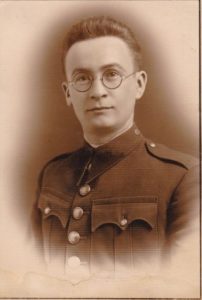
As Hitler was gaining power in Germany; everyone in Europe knew what was coming. The Czechoslovakian army prepared for war. One day while father was working in the dental clinic, an army officer shows up to hand everyone a rifle. My father said ‘I don’t know how to use it’. The officer responded ‘when the time comes, you’ll know how to use it.’ That was the story father told me.
Another thing he said: First the Hungarians came into town and caused havoc; then the Poles came in and caused havoc, followed by the Ukrainians and finally the Russians. They all came in over time and caused damage and havoc.
When Czechoslovakia was taken over by the Germans, my father was sent to slave labor camps (including Mathausen); he served on the Russian border digging tank ditches. That’s the little that I know of what he went through and how he survived. Essentially he didn’t want to talk about what happened to him.
Later in life when father was in his 60s, I told him that since he’s getting older he may want to write his memoirs of what happened to him, his experiences and how he survived the War. I told him that Rivka’s parents are writing their memoirs. His response, which I’ll never forget, was ‘I spent my life trying to forget, no memoirs’. Growing up I remember there were times that he had nightmares and woke up screaming; so what can I say?
In the back of his head my father had a deep gash that didn’t heal properly – the gash was clearly visible, especially after a haircut. As a child, I asked him what that wound was and how he got it; he replied ‘the Germans did it’. Nothing more, no further details; I dropped the subject.
Many decades later, it was only when seeing the film ‘Shindler’s List’ did I realize what happened to my father and how he got the head wound: There is an ugly scene in the film wherein a German soldier takes the butt of a revolver and with great force slams it into the head of a prisoner; it was at that moment I realized what happened to my father and how he got the deep gash. There were many other scenes in that movie that I related to – I visualized my parents there, based on the few stories I heard as a child.
In my presence my parents did not talk about the War and their experiences, so I know very little.
My Mother’s story…
Mother was a seamstress.
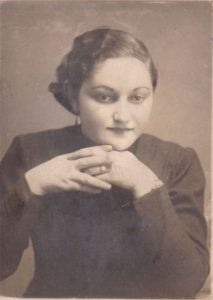
She is the 2nd youngest of 11 children. The youngest is aunt Ruth (Ruchele). My mother, aunt Ruchele and one older sister (aunt Henja) survived the War. An older brother (uncle Al) also survived because he came to America prior to the War. The story is that he was a stowaway on a ship heading to America; he jumped ship in New York harbor. But this is a story for another time.
I don’t know aunt Henja’s story or how she survived or what happened to her; she didn’t talk about it.
Mother and aunt Ruchele were together throughout the war; they both were in the Auschwitz concentration camp. They both have number tattoos on their forearms. Mother didn’t talk much about her experiences, however I remember her saying that she walked by the ‘crematoria’ while in Auschwitz. Turns out that while in Auschwitz they both worked as slave laborers in an ammunition’s factory associated with Auschwitz. Every morning they lined up and were marched through the adjacent city to the munitions factory to work; in the evening, they again lined up and marched back to Auschwitz.
Mother passed away from illness at the relatively young age of 60, this was well before Spielberg’s Shoah Project, so she gave no testimony. Aunt Ruchele did participate in the Project and did give testimony, so aunt Ruchele’s experiences were also my mother’s experiences.
As you scroll down you’ll come to the section on the Spielberg Shoah Project wherein you can view aunt Ruchele’s testimony and the testimonies others too.
Rivka’s parents:
Malka Scherman
Yaakov Scherman
They did not know each other before the War. Rivka’s father was married prior to the War; he had 3 small sons; his wife and sons did not survive the War. Rivka’s parents are from Poland: Rivka’s father from a small town called “Grebow”; Rivka’s mother from Krakow – Poland’s capital city.
Spielberg Shoah Testimonies Testimonies of family members (WARNING: the material is very graphic!)
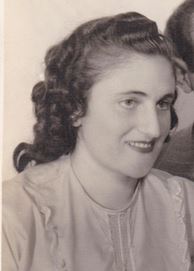
Ruth Rosenblum (aunt Ruth) or as we called her “Tante Ruchele” (where the word “Tante” means “aunt” in Yiddish and German. Tante Ruchele was my mother’s younger sister (by about 3 years). Since Tante Ruchele and my mother were together throughout the War, Tante Ruchele’s experiences were also my mother’s story.
Tante Ruchele is pictured to the left; the picture was taken after the War.
Click on the picture to be directed to tante Ruchele’s testimony.
If you are NOT directed to the testimony, the link to the testimony is:
https://1drv.ms/f/s!AiBO3ro0bEQ0jIIgF-fZvJhDrGdEqA?e=MmCKd5
Copy and paste the link into your Internet browser.
Berta Yozawitz (aunt Berta) or as we called her “tante Berta“. Tante Berta was my father’s younger sister .
Tante Berta is pictured to the right; I believe this picture was taken after the War.
Click on the picture to be directed to Tante Berta’s Shoah’s testimony.
If you are NOT directed to the testimony, the link to the testimony is:
https://1drv.ms/f/s!AiBO3ro0bEQ0jIIKp-AUjDntWwGIjw?e=PLkb4l
Copy the link and paste into your Internet browser.
Caution: The testimony in Yiddish is more horrific than that of the English testimony.
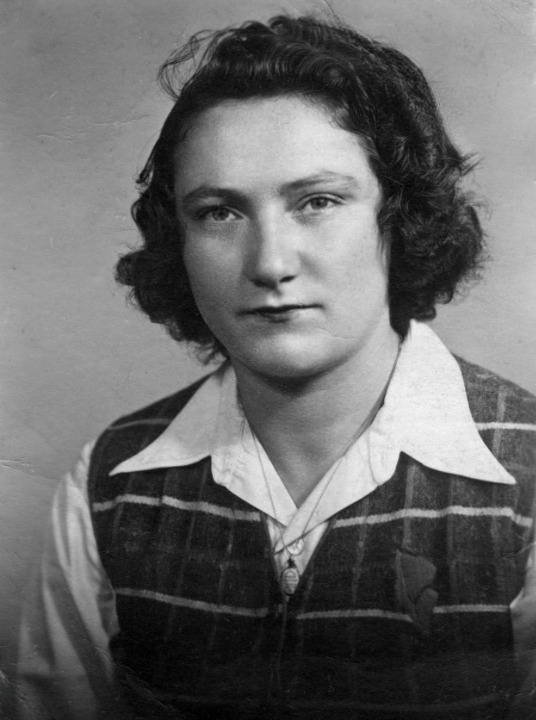
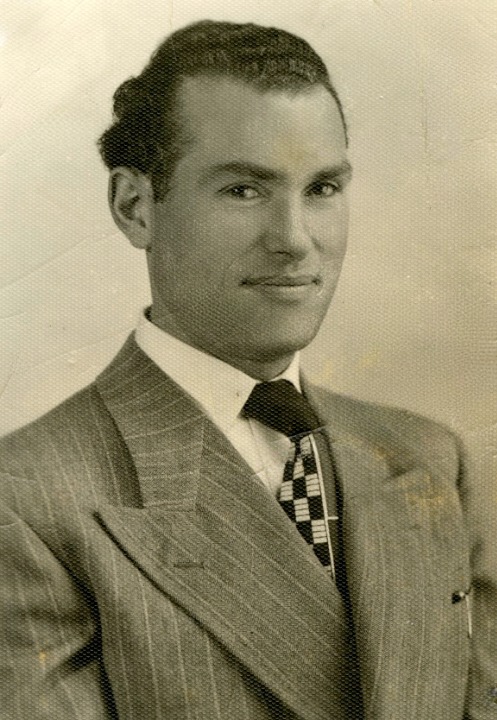
Perry Rosenblum (uncle Perry) or as we called him “Onkel Perry” (where the word “Onkel” means “uncle” in Yiddish and German). Uncle Perry was Aunt Ruchele’s husband. At the start of the war uncle Perry fled to Russia; being in Russia during the War was not a picnic, however the survival rate of those who fled to Russia was higher then those unfortunates who were in the German concentration camps.
Uncle Perry is shown to the right; I believe this picture was taken after the War.
Click on the picture to be directed to Uncle Perry’s Shoah testimony.
If you are NOT directed to the testimony, the link to the testimony is:
https://1drv.ms/f/s!AiBO3ro0bEQ0jIIXAJPD_55wHbaHvg?e=QCtdPt
Copy the link are paste into your Internet browser.
Sigmondo Sherman is the brother of Rivka’s father Yaakov Sherman. After the War he received a visa to immigrate to Argentina (at that time, survivors took whatever visa they could get – the ‘idea’ was simply to get out of Europe), where he lived for the rest of his life.
His testimony is in Spanish; we have a translation somewhere – can’t find it for now.
Sigmondo Scherman’s picture is to the right; the photo was taken after the War.
Click on the picture to be directed to his Shoah testimony.
If you are NOT directed to the testimony, the link to the testimony is:
https://1drv.ms/f/s!AiBO3ro0bEQ0jIIlQuex_3m4GKVvpA?e=PfO4TT
Copy this link and paste into your Internet browser.
Paula Keiter is Perry Rosenblum’s only surviving sister.
I never met her but her story is interesting, so it’s included.
Click on the picture to the left to view Paula’s testimony.
If you are NOT directed to the testimony, the link to the testimony is:
https://1drv.ms/f/s!AiBO3ro0bEQ0jIIQkV2Fu8CGeyBhNw?e=8XkyPz
Copy this link and paste into your Internet browser.
German government documents Arlosen-Archives.Org
Arlosen-Archives.Org
Arlosen-Archives.Org is a German government organization that provides information on victems of Nazi persecution.
I requested material from them on my parents.
Father
This is the material I received from the Arlosen Archives.
The material is in German; I did not translate into English.
Each file is a PDF; when you click, it should open in a separate tab.
Mother/Me
I requested information on my mother. They came back stating that they also had information on me – which I requested. Turns out that since I was born in a DP (Displaced Persons – aka “refugee” camp). I too am listed in some of the material. Again, It’s all in German; no translation provided.
Each file is a PDF; when you click, it should open in a separate tab.
Grave Site Photos (Click on an image to enlarge)
The graves of my parents are in ‘Har HaManuchot’ cemetery at the entrance to Jerusalem in Israel.
Transliteration of my father’s gravestone: .
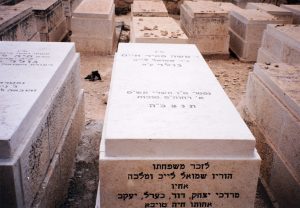
On the bottom of the gravestone is a listing of his siblings who were murdered in the Shoah by the Nazi Germans.
The names of the siblings are:
The graves of Rivka’s parents are in the Kiryat Bialik Israel cemetery.
Transliteration of Rivka’s father’s gravestone: .
On the bottom of the gravestone is a listing of his siblings who were murdered in the Shoah by the Nazi Germans.
The names of the siblings are: